
The story of Jacob’s daughter Dinah is problematic for many Bible readers. The chapter in the book of Genesis in which she appeared is often referred to as the “rape of Dinah.” After her abduction by the prince of Shechem and her subsequent marriage to him, her brothers Levi and Simeon carried out the murder of her husband and all the menfolk in the land, citing the dishonor done to their family. After this narrative, Dinah was never heard of again.
Similar to most female characters in the Bible, Dinah is silent. Other then the notation of her birth in an earlier chapter, what is written about her spans the thirty-one short verses in Genesis 34, none of which are direct quotations from her.
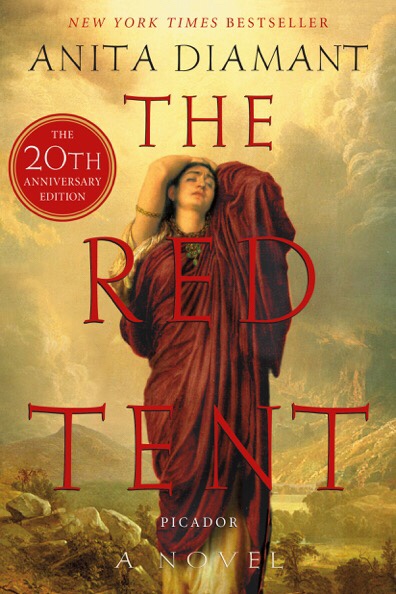
In The Red Tent by Anita Diamant, however, Dinah’s role, and those of the other women in the narrative, are greatly expanded. Jacob’s wives, Leah and Rachel, evolved from sisters competing for the love of one man: they became leaders of the women in their tribe, guardians of women’s secret and sacred traditions. Their handmaids, Bilhah and Zilpah, transformed from slave girls and concubines, to sisters and co-mothers of the Jacob’s wives. Dinah, as the only girl among a brood of boys, became the cherished daughter of four mothers, the vessel of their hopes and dreams.
Much of the secret lives of these women took place in the red tent: it was the place where, under ancient law, women go into seclusion during menstruation or after childbirth. It was here where their bonds are formed and strengthened, where they were bolstered by the encouragement and support of the other women in the tribe.
Dinah’s idyllic relationship with her family came to an end when she entered into her ill-fated marriage with Shalem, resulting into his murder at the hands of her brothers.
Cursing her father and brothers, she fled together with Shalem’s mother to Egypt where her mother-in-law raised her son among her family of scribes.
In the years that followed, Dinah built a life for herself: she became known for her skills in midwifery, she developed a close friendship with a fellow midwife, Meryt and was welcomed into her family, and she found new love in Benia, a woodworker in the Valley of Kings.
She would then encounter her long-lost brother, Joseph, who has risen high to become the Grand Vizier of Egypt, and who proposed to bring her back to her father’s camp to see him before he dies.


In this retelling of the Biblical tale, Diamant sheds light on the secret lives of women in ancient times. Their stories and traditions are passed down from mother to daughter, sister to sisters. Their bodies are celebrated and consecrated to their goddesses. Their roles within the tribes are shown as vital: they are caretakers, nurturers and healers, not just of their own children but of the whole community.
Diamant also calls attention to the weakness of men: how Jacob’s negligence of his sons resulted in the murder of Shalem and Joseph’s slavery in Egypt; how the malice of Simeon and Levi tore their family apart; and how Shalem’s love for Dinah made him agree to her brothers’ demands which resulted to the destruction of his people.
The novel is also one of hope: in the Bible, Dinah disappears from the narrative after the prince’s murder while in The Red Tent, she was able to forge her own path away from the protection of her family.
It also paints Egyptians, particularly the common people, in a new light, very far from depictions of oppressive slave-drivers towards Hebrews. Here, they are regular folks – midwives, scribes, carpenters and bakers – who are all simply living their lives.
The Red Tent is an important work, not just as a retelling of a Biblical tale, but as a depiction of the secret lives of women in ancient times. While Dinah, Leah, Rachel and their ilk were given minor roles in the Holy Book, in this novel, their lives and their stories are front and center.
I highly recommend this book to fans of Biblical fiction.
Click here to buy this book on Amazon.com.
In 2014, The Red Tent was adapted into a two-part miniseries starring Rebecca Ferguson (“Mission Impossible: Rogue Nation, ” “The White Queen“) as Dinah, Minnie Driver (“Sleepers,” “Grosse Pointe Blank“) as Leah, Morena Baccarin (“Deadpool,” “Gotham“) as Rachel and Iain Glenn (“Game of Thrones“) as Jacob. Click here to watch the The Red Tent on Amazon Prime. Watch it for free when you sign up for your 30-day trial.
Love books and reading? Try Kindle Unlimited on Amazon. Get your first month FREE.
No Kindle device? Download the Kindle App for FREE to read your favorite books anytime and anywhere.
No time to read? Listen to your favorite books instead while you drive, run, shop, and more. Try Audible for free for 30 days and get two free audiobooks.

 Jellybeans in the City